
Seven Places

\Indian Palms is a country club community in Indio, about forty miles east of Palm Springs. Depending on how you count, news about this place gets published in about seven different places, and often no place at all. And no two of them know the other five exist.
Two association websites that don't link to each other. Three resident Facebook groups. Hangar 19, the club restaurant, which advertises almost entirely in poster images captioned something like "New Venue for Tonight Enjoy," or with no caption at all. And a bulletin board, if you're feeling generous and counting a bulletin board as a system.
The formats don't match either. Some events go up as real calendar entries with a date on them. Some are a picture somebody made using AI and posted at nine at night, where the date only exists inside the image. Some aren't posted as events at all, just one sentence in the middle of a comment thread about golf carts or to an Instagram page.
It's worth stopping on that one, because it isn't just an Indian Palms problem, it's everywhere now. Somewhere in the last few years we quietly decided that the correct way to announce a thing, a date, a time, a place people need to write down and act on, is to type it into an image generator, get back a poster with a sunset and some confident lettering, and post that. No text. No date field. No link. Just a picture of the information, which is a strange thing to do to information.
Think about what that actually is. You take something whose entire purpose is to be found, remembered, and searched for, and you seal it inside the one format that can't be found, remembered, or searched. A poster is a dead end by design. You can't copy the date off it. You can't search your messages for it later. A calendar can't read it. A screen reader can't read it to someone who's blind. It exists to be looked at once, in the feed, on the night it went up, and then to sink. We've taken the flyer, the least durable object in the history of announcements, the thing that used to get stapled to a telephone pole and rained on, and built a digital version that's somehow worse, because at least the telephone pole was on a corner everyone walked past.
I'm not sure anyone ever decided this was a good idea. It just became the default, the way defaults do, one person copying the last person, until the poster of an event quietly replaced the event itself. And I get the appeal. It looks nice. It takes five minutes. But nice and fast are doing a lot of quiet damage to whether anyone actually finds out about anything.
Anyway. That's a bigger rant than this post needs, and none of it is really the point. The point is smaller and closer to home: all of this is happening here, in one square-mile country club community, and no one has put it in one place.
So the information is public. It's just functionally invisible unless checking seven places a day is a hobby you've taken up.
The eighth place, which isn't a place
While I was writing this, IPMA, our master association, sent out an update by email. Useful information, the kind of thing you'd want to know.
It is not on their website. It is not in any of the three groups. Nobody texted it. The email does contain a link, a proper call-to-action button, the kind that makes you believe clicking it will land you on the post it's teasing. It doesn't. It drops you on a page that mentions none of it.
So whether that update reached you comes down entirely to whether management has a working email address for you. For a lot of people here, the address on file is one they set up in 2009 and haven't opened since. If you bought last year, if you switched providers, if one of these went to spam once and Gmail took the hint, then as far as you're concerned that update was never sent at all.
I did offer
Before anyone accuses me of going around the association(s), I knocked on the front door first. Several times, over a long stretch.
I wrote to the board offering to help with the technology. Unpaid volunteer, or as a consultant if that was cleaner to account for, whichever they preferred. The website, how notices go out, meeting audio, any of it. I've spent twenty-some years doing this work professionally and I own a house here, which makes me roughly the cheapest technology vendor this association will ever be offered.
I never got a reply. Not a no, which would have been a perfectly reasonable answer and would have let me get on with my life. Just nothing at all.
Then a board meeting recently mentioned technology and the website repeatedly, so I offered one more time, on the theory that the earlier ones had maybe landed in a spam folder. Same result.
There's a point where waiting for a response stops being patience and becomes a hobby of its own. So I started building the part I could build without anyone's permission.
Honestly, it didn't start as a community project at all. It started as a thing for me. I was tired of checking seven places just to keep track of my own life here, the association notices, the club menu, when the gates were going to be a problem, what was happening around the valley that weekend. So I built a little utility to pull it all into one place, purely so I'd stop missing things. It was only once it was working, once I was actually caught up for the first time in ages, that it occurred to me the exact problem I'd just solved for myself was one basically everyone here has. If it was saving me from the seven-tab shuffle, it could save my neighbors too. So I cleaned it up and pointed it outward.
I can't fix the association's website, because it isn't mine to fix. I can't change how notices go out, because that isn't my mailing list. What I can do is take everything that already gets posted in public and put it somewhere you can actually read it.
It's called The Palms Commons.
What it does
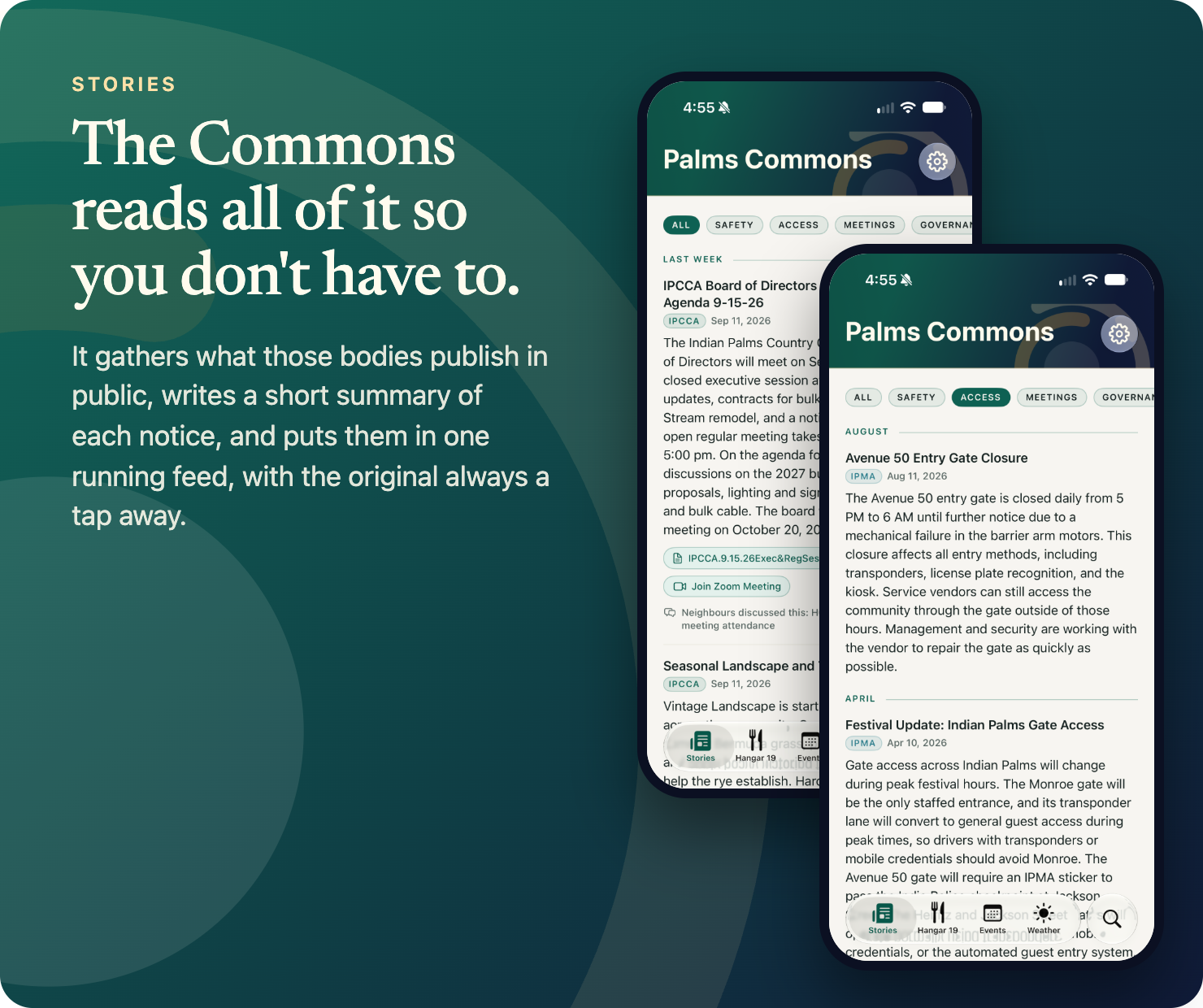
The Commons reads all of it so you don't have to. It gathers what those bodies publish in public, writes a short summary of each notice, and puts them in one running feed, with the original always a tap away.
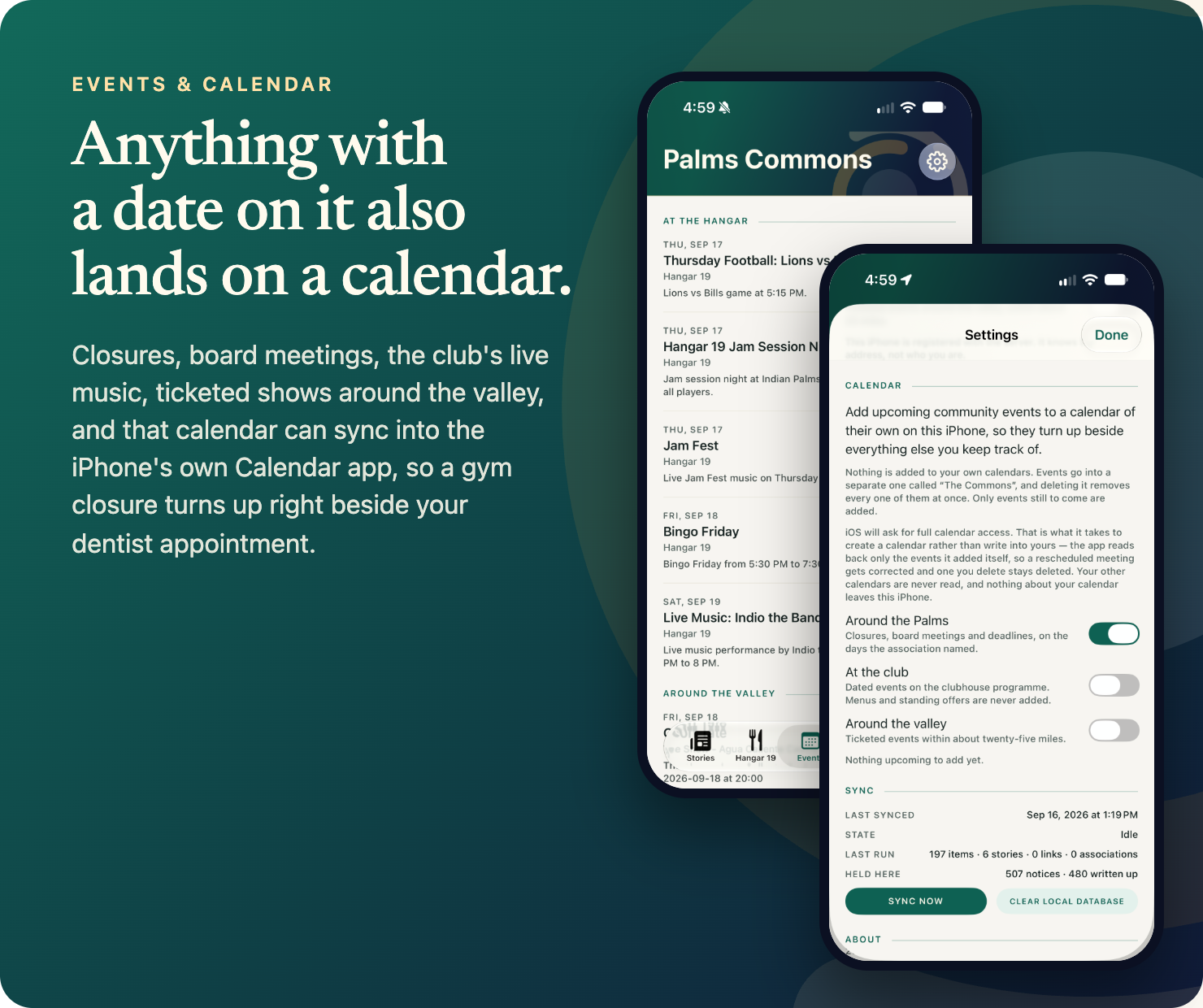
Anything with a date on it also lands on a calendar, closures, board meetings, the club's live music, ticketed shows around the valley, and that calendar can sync into the iPhone's own Calendar app, so a gym closure turns up right beside your dentist appointment.
There's a week of weather with the air quality reading that actually matters in a desert summer, a page for what the kitchen is serving tonight, and notifications for the handful of things worth interrupting you for: gate and road closures, weather warnings, and association business. Nothing else buzzes your phone.
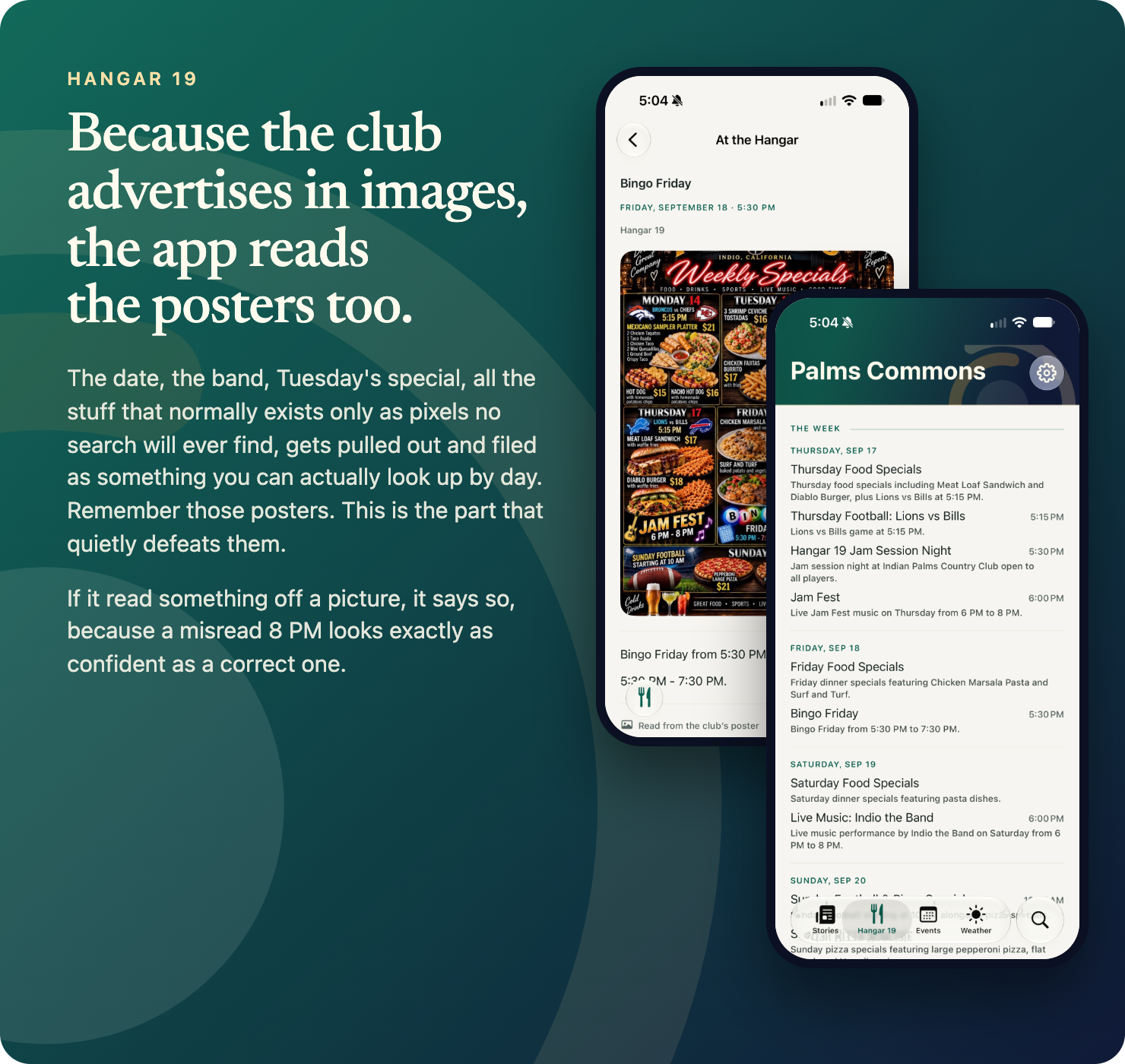
And because the club advertises in images, the app reads the posters too. The date, the band, Tuesday's special, all the stuff that normally exists only as pixels no search will ever find, gets pulled out and filed as something you can actually look up by day. Remember those posters. This is the part that quietly defeats them. If it read something off a picture, it says so, because a misread 8 PM looks exactly as confident as a correct one.
It's not official, and it says so on the first screen
This is the most important thing on the page, so it doesn't live in a footer.
The Commons isn't run by, affiliated with, or endorsed by any association or by the club. It collects public postings and names the source of every single one. And the summaries are written by a machine, which means they can be wrong about a date, an amount, or who's affected. So anything involving money, a deadline, or a rule links straight back to the association's own notice, which is the thing that counts.
It's a convenience, not a record. When it matters, go to the source, and the source is always one tap away.
Built for the people who actually live here
Most of the design decisions come from who's really on the other end of it. The readership here skews older and reads on iPads, so it's built for both iPhone and iPad. It respects the text size you've set system-wide, and it keeps a line of text to a readable width instead of stretching it across a 13-inch screen.
There's no account to make, no feed to curate, and nothing to configure before it's useful. You open it, and the neighborhood is there. It's real software, built from scratch for exactly this, not a template with the neighborhood's name pasted on top.
What's in it, and what isn't yet
Two association sites to start, IPMA and IPCCA, which are the two I happen to belong to. That's the entire selection criteria. It isn't coverage, it's a guy solving his own problem and being honest that the problem was his. There are a lot more associations here than two, and if yours publishes its notices somewhere I can reach, tell me where and I'll look at adding it.
It's an iPhone app to start, built for iPhone and iPad, and yes, that leaves some of you out for now. I'm not going to dress that up. Wider support is on the list, and how fast depends on how many people tell me they need it.
It's out
The Palms Commons is on the App Store now, free, no account to make and nothing to configure. You open it and the neighborhood is there.
 Kyle Johnson
The offer to the association still stands, too, and it's bigger than this app. If a board ever wants The Palms Commons, they can have it, keys and all, free. And if they'd rather keep it in their own hands and just communicate well across all these platforms themselves, I'm glad to help with that too. However they want to do it. I'd genuinely rather they did it themselves and I went back to my regular life.
Until then, it's yours. Go see what you've been missing.


Member discussion